ON SALE
ON SALE
Yasir
✓
and — people purchased

₨ 14,000
₨ 15,000

Days
Hours
Min
Sec
₨ 178,880 Original price was: ₨ 178,880.₨ 134,999Current price is: ₨ 134,999.
Brand: TP-Link
Series: TL-JetStream
Model: TL-SG3428XMP
Color: Black
Recommended For: Business
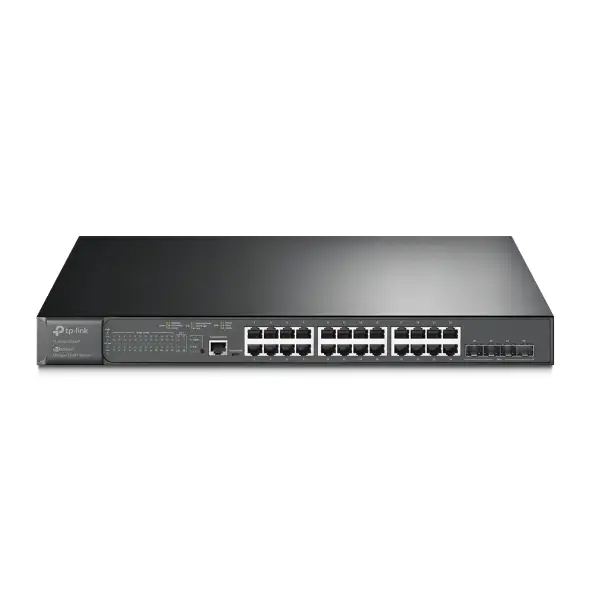
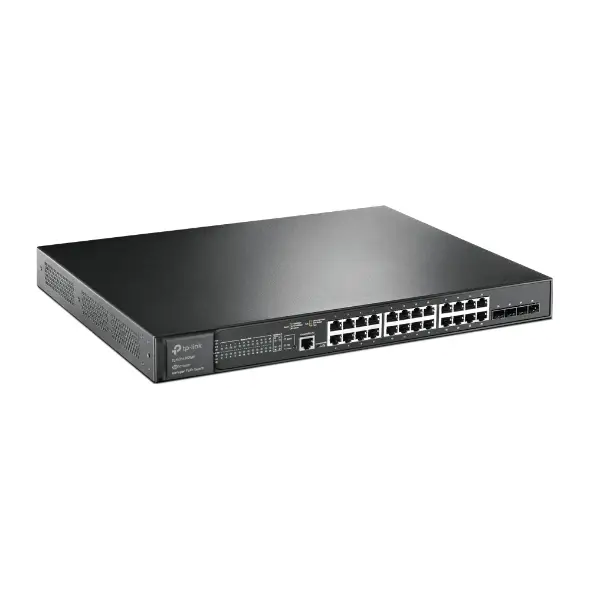
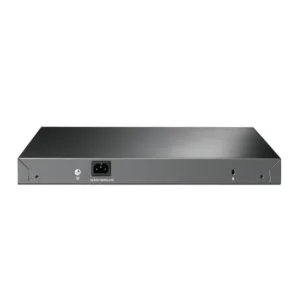
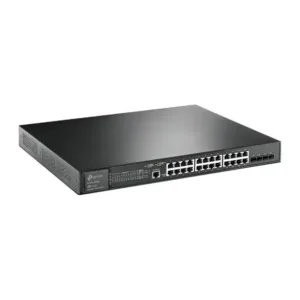
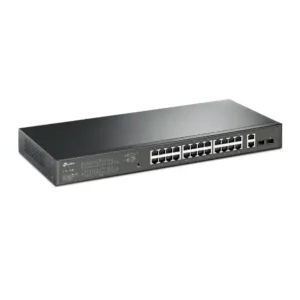
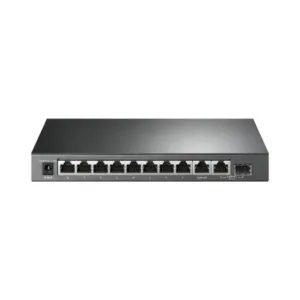
TL-SG3428XMP is a JetStream 24-Port Gigabit and 4-Port 10GE SFP+ L2+ Managed Switch of TP-Link. With 24 PoE+ ports, TL-SG3428XMP makes a well-managed switch for TP-Link Pakistan.
Share to your buddy !
| HARDWARE FEATURES | |
| Interface | • 24× 10/100/1000 Mbps RJ45 Ports |
| • 4× 10G SFP+ Slots | |
| • 1× RJ45 Console Port | |
| • 1× Micro-USB Console Port | |
| Fan Quantity | 2 |
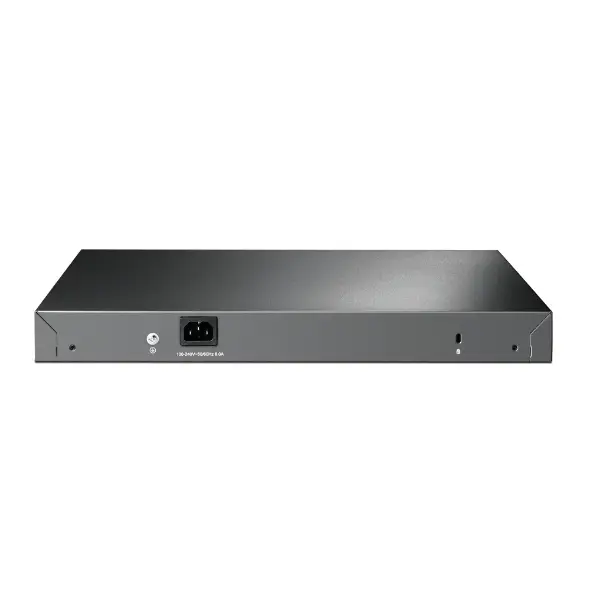
| Power Supply | 100-240 V AC~50/60 Hz |
| PoE+ Ports(RJ45) | • Standard: 802.3at/af compliant |
| • PoE+ Ports: 24 Ports, up to 30 W per port | |
| • Power Budget: 384 W | |
| Dimensions | 17.3 × 13.0 × 1.7 in (440 × 330 × 44 mm) |
| Mounting | Rack Mountable |
| Max Power Consumption | 34.4 W (110V/60Hz) (no PD device connected) |
| 465.8 W (110V/60Hz) (with 384 W PD device connected) | |
| Max Heat Dissipation | 117.38 BTU/h (110 V/60 Hz) (no PD device connected) |
| 1589.31 BTU/h (110 V/60 Hz) (with 384 W PD device connected) | |
| PERFORMANCE | |
| Switching Capacity | 128 Gbps |
| Packet Forwarding Rate | 95.23 Mpps |
| MAC Address Table | 16 K |
| Packet Buffer Memory | 12 Mbit |
| Jumbo Frame | 9 KB |
| SOFTWARE FEATURES | |
| Quality of Service | • 8 priority queues |
| • 802.1p CoS/DSCP priority | |
| • Queue scheduling | |
| – SP (Strict Priority) | |
| – WRR (Weighted Round Robin) | |
| – SP+WRR | |
| • Bandwidth Control | |
| – Port/Flow based Rating Limiting | |
| • Smoother Performance | |
| • Action for Flows | |
| – Mirror (to supported interface) | |
| – Redirect (to supported interface) | |
| – Rate Limit | |
| – QoS Remark | |
| L3 Features | • 16 IPv4/IPv6 Interfaces |
| • Static Routing | |
| – 48 static routes | |
| • Static ARP | |
| – 128 Static Entries | |
| • Proxy ARP | |
| • Gratuitous ARP | |
| • DHCP Server | |
| • DHCP Relay | |
| – DHCP Interface Relay | |
| – DHCP VLAN Relay | |
| • DHCP L2 Relay | |
| L2 and L2+ Features | • Link Aggregation |
| – static link aggregation | |
| – 802.3ad LACP | |
| – Up to 8 aggregation groups, containing 8 ports per group | |
| • Spanning Tree Protocol | |
| – 802.1d STP | |
| – 802.1w RSTP | |
| – 802.1s MSTP | |
| – STP Security: TC Protect, BPDU Filter, Root Protect | |
| • Loopback Detection | |
| – Port based | |
| – VLAN based | |
| • Flow Control | |
| – 802.3x Flow Control | |
| – HOL Blocking Prevention | |
| • Mirroring | |
| – Port Mirroring | |
| – CPU Mirroring | |
| – One-to-One | |
| – Many-to-One | |
| – Tx/Rx/Both | |
| L2 Multicast | • IGMP Snooping |
| – IGMP v1/v2/v3 Snooping | |
| – Fast Leave | |
| – IGMP Snooping Querier | |
| – IGMP Authentication | |
| • MLD Snooping | |
| – MLD v1/v2 Snooping | |
| – Fast Leave | |
| – MLD Snooping Querier | |
| – Static Group Config | |
| – Limited IP Multicast | |
| • MVR | |
| • Multicast Filtering | |
| – 256 profiles and 16 entries per profile | |
| Advanced Features | |
| Support | • Omada Hardware Controller (OC200/OC300), Software Controller, Cloud-Based Controller |
| • Automatic Device Discovery | |
| • Batch Configuration | |
| • Batch Firmware Upgrading | |
| • Intelligent Network Monitoring | |
| • Abnormal Event Warnings | |
| • Unified Configuration | |
| • Reboot Schedule | |
| • ZTP (Zero-Touch Provisioning) | |
| VLAN | |
| • VLAN Group | |
| – Max 4K VLAN Groups | |
| • 802.1Q Tagged VLAN | |
| • MAC VLAN: 7 Entries | |
| • Protocol VLAN: Protocol Template 16, Protocol VLAN 16 | |
| • Private VLAN | |
| • GVRP | |
| • VLAN VPN (QinQ) | |
| – Port-Based QinQ | |
| – Selective QinQ | |
| • Voice VLAN | |
| Access Control List | |
| • Time-based ACL | |
| • MAC ACL | |
| – Source MAC | |
| – Destination MAC | |
| – VLAN ID | |
| – User Priority | |
| – Ether Type | |
| • IP ACL | |
| – Source IP | |
| – Destination IP | |
| – Fragment | |
| – IP Protocol | |
| – TCP Flag | |
| – TCP/UDP Port | |
| – DSCP/IP TOS | |
| – User Priority | |
| • Combined ACL | |
| • Packet Content ACL | |
| • IPv6 ACL | |
| • Policy | |
| – Mirroring | |
| – Redirect | |
| – Rate Limit | |
| – QoS Remark | |
| • ACL applies to Port/VLAN | |
| Security | |
| • IP-MAC-Port Binding | |
| – 512 Entries | |
| • DHCP Snooping | |
| • ARP Inspection | |
| • IPv4 Source Guard: 100 Entries | |
| • IPv6-MAC-Port Binding | |
| – 512 Entries | |
| • DHCPv6 Snooping | |
| • ND Detection | |
| • IPv6 Source Guard: 100 Entries | |
| • DoS Defend | |
| • Static/Dynamic Port Security | |
| – Up to 64 MAC addresses per port | |
| • Broadcast/Multicast/Unicast Storm Control | |
| – kbps/ratio control mode | |
| • 802.1X | |
| – Port base authentication | |
| – Mac base authentication | |
| – VLAN Assignment | |
| – MAB | |
| – Guest VLAN | |
| – Support Radius authentication and accountability | |
| • AAA (including TACACS+) | |
| • Port Isolation | |
| • Secure web management through HTTPS with SSLv3/TLS 1.2 | |
| • Secure Command Line Interface (CLI) management with SSHv1/SSHv2 | |
| • IP/Port/MAC-based access control | |
| IPv6 Features | |
| IPv6 Dual IPv4/IPv6 | |
| IPv6 Dual IPv4/IPv6 Discovery (MLD) Snooping | |
| IPv6 ACL | |
| IPv6 Interface | |
| Static IPv6 Routing | |
| IPv6 neighbor discovery (ND) | |
| Path maximum transmission unit (MTU) discovery | |
| Internet Control Message Protocol (ICMP) version 6 | |
| TCPv6/UDPv6 | |
| IPv6 applications | |
| DHCPv6 Client | |
| Ping6 | |
| Tracert6 | |
| Telnet (v6) | |
| IPv6 SNMP | |
| IPv6 SSH | |
| IPv6 SSL | |
| Http/Https | |
| IPv6 TFTP | |
| Management | |
| Web-based GUI | |
| Command Line Interface (CLI) through the console port, telnet | |
| SNMP v1/v2c/v3 | |
| Trap/Inform | |
| RMON (1,2,3,9 groups) | |
| SDM Template | |
| DHCP/BOOTP Client | |
| 802.1ab LLDP/LLDP-MED | |
| DHCP AutoInstall | |
| Dual Image, Dual Configuration | |
| CPU Monitoring | |
| Cable Diagnostics | |
| EEE | |
| Password Recovery | |
| SNTP | |
| System Log | |
| MIBs | |
| MIB II (RFC1213) | MIB II (RFC1213) |
| Interface MIB (RFC2233) | Interface MIB (RFC2233) |
| Ethernet Interface MIB (RFC1643) | Ethernet Interface MIB (RFC1643) |
| Bridge MIB (RFC1493) | Bridge MIB (RFC1493) |
| P/Q-Bridge MIB (RFC2674) | P/Q-Bridge MIB (RFC2674) |
| RMON MIB (RFC2819) | RMON MIB (RFC2819) |
| RMON2 MIB (RFC2021) | |
| Radius Accounting Client MIB (RFC2620) | |
| Radius Authentication Client MIB (RFC2618) | |
| Remote Ping, Traceroute MIB (RFC2925) | |
| Support TP-Link, private MIB, | |
| MANAGEMENT | |
| Omada App | Yes. Requiring OC300, OC200, Omada Cloud-Based Controller, or Omada Software Controller. |
| Centralized Management | |
| • Omada Cloud-Based Controller
• Omada Hardware Controller (OC300) • Omada Hardware Controller (OC200) • Omada Software Controller |
|
| Cloud Access | Yes. Requiring OC300, OC200, Omada Cloud-Based Controller, or Omada Software Controller. |
| Zero-Touch Provisioning | Yes. Requiring the use of Omada Cloud-Based Controller. |
| Management Features | • Web-based GUI
• Command Line Interface (CLI) through the console port, telnet • SNMP v1/v2c/v3 – Trap/Inform – RMON (1,2,3,9 groups) • SDM Template • DHCP/BOOTP Client • 802.1ab LLDP/LLDP-MED • DHCP AutoInstall • Dual Image, Dual Configuration • CPU Monitoring • Cable Diagnostics • EEE • Password Recovery • SNTP • System Log |
| OTHERS | |
| Certification | CE, FCC, RoHS |
| Package Contents | • TL-SG3428XMP Switch |
| • Power Cord | |
| • Quick Installation Guide | |
| • Rackmount Kit | |
| • Rubber Feet | |
| System Requirements | Microsoft® Windows® 98SE, NT, 2000, XP, Vista™ or Windows 7/8/10/11, MAC® OS, NetWare®, UNIX® or Linux. |
| Environment | • Operating Temperature: 0–45 ℃ (32–113 ℉);
• Storage Temperature: -40–70 ℃ (-40–158 ℉) • Operating Humidity: 10–90% RH non-condensing • Storage Humidity: 5–90% RH non-condensing |
| Feature | TP-Link-TL-SG3428XMP | TL-SG3428 | TL-SG3428X |
| Price | Rs. 175,000 | Rs. 64,500 | Rs.91,000 |
| Ports | 24 Gigabit | 24 Gigabit | 24 Gigabit |
| PoE+ Support | Yes | No | Yes |
| Jumbo Frame | 9 KB | 9 KB | 9 KB |
Check TP-Link’s official website for the listed product’s warranty,


Welcome to the Techtrix Store! Pakistan’s trusted source for computers and networking solutions. Explore our extensive range of products from Dell, Lenovo, HP, Tp-Link, Cisco, Asus, Linksys, Deli, and other major global tech brands all offered at competitive prices. As an official TP-Link Partner in Pakistan & Trusted Cisco distributor in Pakistan, we guarantee quality products and exceptional customer service.